TL;DR: A flooded electrical panel is not a “dry it out” call. Tell the caller to shut off power only from a dry location, stay out of standing water, and do not restore power until a qualified electrician inspects the equipment.
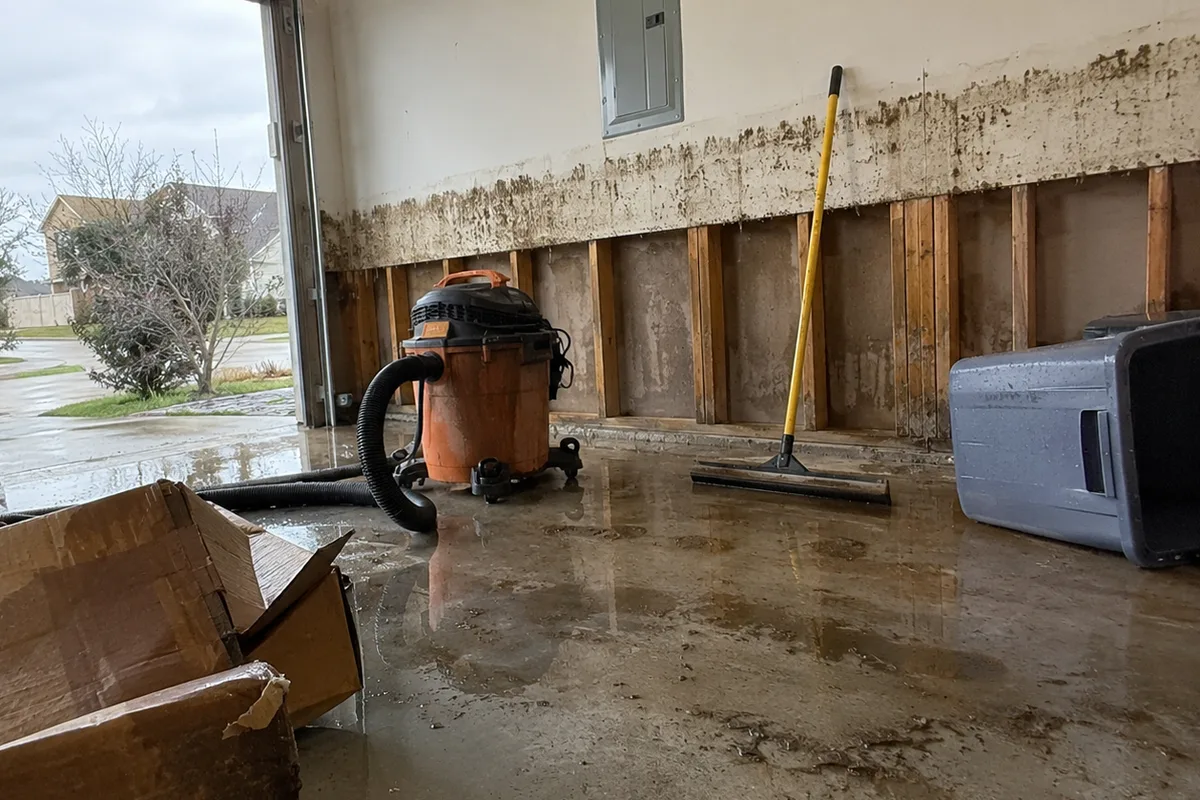
“The garage flooded and the panel is in there” is not a normal no-power call
Start with the water, not the schedule.
Electrical equipment exposed to water can be extremely hazardous if it is reenergized without a proper evaluation. NEMA applies that warning to flooding, fire-fighting, hurricanes, and other large-water events. The danger is not limited to a panel that looks visibly damaged.
Flood water can carry chemicals, sewage, oil, and debris. Ocean water and salt spray are particularly damaging because saltwater residue is both corrosive and conductive. A garage flood involving clean rainwater still requires an evaluation. A garage flood involving sewage or saltwater raises a different level of concern for the equipment and the person approaching it.
The first intake question is not, “What time can we send someone?”
Ask whether there is standing water between the caller and the panel. Then ask whether the panel itself is wet. Those answers determine whether the caller can safely reach the service panel at all.
Ask where the water went before asking when you can arrive
The order of the questions matters.
Wirewoman asks about standing water and whether the caller can reach the panel from dry ground before she asks about scheduling. The SMS summary the owner receives puts whether water reached the panel and whether standing water is on the way to it near the top. It does not bury those facts under an address and a time slot.
Use direct questions:
- Is there standing water between you and the panel?
- Can you reach the main breaker or fuse from a dry location?
- Did water reach the panel?
- Did water reach outlets, switches, appliances, or the meter?
- Is the water fresh water, sewage, or salt or coastal water?
- Is there full power loss, sparking, smoke, or a burning smell?
Ask whether outlets, cords, or appliances are submerged or wet. ESFI warns that submerged outlets or cords can energize the water. Wet appliances must not be turned on or plugged in unless an electrician says they are safe. The caller should not run wet appliances while waiting.
Do not turn this into a diagnosis over the phone. It is a safety screen and a scope screen.
The caller can shut off power only from dry ground
CDC guidance is specific. If water has been near electrical circuits and equipment, the caller may turn off power at the main breaker or fuse on the service panel only if the caller can do it from a dry location.
If standing water must be entered to reach the main switch, the caller should stay out and call an electrician to turn it off. Never turn power on or off while standing in water. Never use an electric tool or appliance while standing in water.
Tell the caller not to reset breakers. Do not ask the caller to test outlets. Do not ask the caller to plug in a device to see whether power has returned. Do not ask the caller to move a wet appliance or cord.
Power stays off until the equipment has been inspected by a qualified electrician. ESFI also says to have a qualified electrician check the house wiring before repairs proceed.
That gives your answering service a clear script:
If you can reach the main shutoff from a completely dry location, turn it off. If you would have to enter standing water, do not approach it. Do not reset breakers, plug anything in, or run wet appliances. A qualified electrician must inspect the equipment before power is restored.
The wording matters. “Try resetting the breaker” is ordinary advice for an ordinary no-power call. It is unsafe advice for water-damaged equipment.
For related call screening, keep your emergency guidance consistent with your shop’s existing electrical emergency process and emergency service information.
NEMA’s table gives you a replacement list, not a drying promise
The honest quote starts with what the water touched.
NEMA’s table says to replace molded-case circuit breakers, low-voltage fuses, switches, AFCI and GFCI devices, surge-protective devices, and wiring devices such as switches, receptacles, and dimmers.
It also says to replace outlet and junction boxes, fittings, wire or cable listed only for dry locations, lighting equipment, batteries, and dry-type transformers regardless of kVA. NEMA gives NM-B as an example of wire or cable listed only for dry locations.
That is the scope your intake notes need to support. If water reached the panel and the connected devices, do not sell the job as “drying out the panel.” Quote the equipment that NEMA identifies for replacement based on the evaluation and the actual areas affected.
The panelboard is different. NEMA says panelboards may be reconditioned, but only after contacting the manufacturer. NEMA also lists switchboards, conduit and tubing, and wire or cable suitable for wet locations as equipment that may be reconditioned under stated conditions. For wet-location wire or cable, the ends must not have been exposed to water, and the wire must not be damaged.
That is not permission to promise reconditioning on the first call. It is a reason to leave the scope open until the electrician evaluates the equipment and the manufacturer is contacted where required.
A caller may ask, “Can’t you just dry it out?” The answer should be plain:
Some equipment is replaced after water exposure. Some equipment may be reconditioned only after the manufacturer is contacted and the equipment is evaluated. We cannot promise that drying the panel will make it safe.
NEMA warns that attempts to recondition equipment without consulting the manufacturer can create added hazards. Improper cleaning agents and improper reconditioning techniques are part of the problem. NEMA points to NEC 110.11 Informational Note No. 2 in that warning.
Do not give a fixed flooded-panel price before checking the AHJ
The authority having jurisdiction, or AHJ, should be consulted about rules for replacing or reconditioning water-damaged equipment. That includes permitting and inspection requirements in locally adopted codes.
For a C-10 shop, this belongs in the quoting workflow. Before you promise a fixed price, check with the local building department about the applicable permitting and inspection requirements. Do not turn the first phone call into a final price when the equipment list, manufacturer direction, and AHJ requirements are not known.
Your quote can state the work in the terms the evaluation supports:
- Replace breakers and fuses identified by the evaluation.
- Replace wet switches, receptacles, dimmers, AFCI devices, GFCI devices, and surge-protective devices.
- Replace wet outlet and junction boxes and fittings.
- Replace dry-location-only cable, including NM-B where applicable.
- Evaluate the panelboard for possible reconditioning only through the manufacturer.
- Check the local building department for permitting and inspection requirements before the work is finalized.
Do not promise that the enclosure will be reconditioned. Do not promise that every conductor can stay. Do not promise that a panel that appears dry is safe to energize.
Your estimate should separate the evaluation from the replacement or reconditioning decision. That protects the caller from a false “dry and reset” answer and protects the shop from quoting work that cannot be defined yet.
Emergency pricing still has a rule
A winter storm can produce a rush of calls. The rush does not remove the need for a written emergency pricing policy.
For California emergency pricing limits during declared emergencies, use the shop’s guidance on SB 1365 and price gouging for electrical repairs. Do not invent a flooded-panel price during intake. Do not let a caller hear one emergency rate from the answering service and another rate from the owner without a stated policy.
The answering service should collect the facts that determine urgency and escalation. The owner or assigned electrician can decide the charge under the shop’s policy after the scope is known.
That policy should also say what happens after hours. Link the intake rules to the after-hours call policy every electrical shop needs, including who receives the escalation and which calls wait for morning.
Wirewoman can put the dangerous words in front of the owner
Wirewoman answers 24/7, sends the job summary by SMS within 30 seconds of hang-up, logs every call to a dashboard, and follows the shop’s own escalation rules.
The owner decides which words ring the cell right away and which wait for morning. A shop can set “water in the panel,” “sparks,” and “burning smell” as immediate escalation terms. Out of the box, Wirewoman treats sparking, smoke, burning smell, and full power loss as emergencies and rings the owner’s cell.
Winter storms can increase electrical call volume. The intake should get safer, not shorter. Keep the screening questions and escalation rules ready with the shop’s winter electrical call plan.
Change the intake before the next storm call
Put standing water and dry access to the main shutoff before scheduling in the phone script. Ask what the water touched, including the panel, outlets, wiring, appliances, and meter. Ask whether the water was fresh, sewage, or salt or coastal water.
Tell the caller to shut off power only from dry ground. If reaching the shutoff requires entering water, tell the caller to stay out and call an electrician. Tell the caller not to reset breakers, plug in equipment, or run wet appliances.
Then quote the job as replace versus recondition. Use NEMA’s replacement list for breakers, fuses, switches, AFCI and GFCI devices, surge protection, wiring devices, boxes, fittings, dry-location-only cable, lighting equipment, batteries, and dry-type transformers. Treat panelboard reconditioning as a manufacturer-contact and evaluation question, not a promise.
Before giving a fixed price, check the AHJ’s permitting and inspection requirements. Apply the shop’s emergency pricing policy. Configure Wirewoman to send the water facts by SMS within 30 seconds and ring the owner for the emergency terms that matter.