TL;DR: Stock the parts your invoices show you use most, not every part available at a supply house. Keep every van arranged the same way, restock used items before the next workday, and read the call summary before the van leaves.
A second trip costs more than the part
Bill Murdy, owner of a Mister Sparky electric franchise on western Long Island, N.Y., has spent 30 years in residential electrical service and more than 25 as an owner. He wrote in EC&M that “one of the most frustrating aspects of running a service business is having your electrician leave the job and drive to the nearest supply house.”
The problem is not only the material. It is the technician’s drive time, the time spent finding the part, and the lost appointment capacity while the van is away. Jon Harrison of Harrison Electric in Plymouth, Minn., put it plainly: “If you spend an hour trip to get something you should already have, then you will not recover that hour.”
Harrison runs eight technicians in box trucks with custom slide-out bins and trays. He estimates that eight electricians wasting 15 minutes a day searching for parts adds up to roughly one and a half weeks lost a year.
That is why truck stock is an operations issue. A van can contain the right material and still waste time if the technician cannot find it quickly. The parts need a fixed location, a clear label, and a replacement process that starts before the next workday.
The call description should change what you load
The best truck stock decision happens before the van leaves.
A call logged as “outlet dead in the kitchen” tells you to load GFCIs and a tester. “Breaker keeps tripping” tells you to bring a different kit. The intake should ask what is wrong, which device or room is involved, and whether anything smells hot or is sparking. That complaint should show up word for word in the call log on the dashboard, so the technician reads it before loading the truck instead of finding out on the doorstep.
Wirewoman answers every call 24/7, sends the job summary by SMS to the shop within 30 seconds of the call ending, and logs every call to the dashboard. Calls flagged urgent are routed by your own escalation rules. The summary is on the technician’s phone before they leave the driveway.
Use that information when you sort the call. For a breaker keeps tripping call, check the panel family and load the testing equipment and likely breaker types before dispatch. For a half-house power loss call, the technician needs the complaint and affected area clearly stated before choosing material.
Panel upgrade calls need a different intake. Use the questions in what to ask before booking a panel upgrade so the technician is not leaving with the same small service kit used for a dead receptacle.
Build the list from your invoices, not a catalog
Murdy recommends reviewing past material invoices to identify the items used most often. That gives you a truck stock list based on your calls, your technicians, and your service area.
Review the invoices by item. Look for the small parts that appear repeatedly. Then account for seasonality. The material used during one part of the year may not match the material used during another.
This process also tells you what not to carry. You do not need every breaker brand, every raceway fitting, or every specialty part in every van. Stock the breaker families that match the panels your customers have most often. Do not stock all brands simply because they exist.
Your list should have three groups:
- Items that belong on every van.
- Items used often enough to keep in the shop or on selected vans.
- Odd or specialty parts that you obtain after the diagnosis or before the appointment.
Murdy recommends a purchase order system with either backup shop inventory or supplier contracts for daily delivery of frequently used small parts. Many larger electrical distributors also offer consignment plans. Those options let you keep common material available without filling every van with slow-moving stock.
These categories cover the common service work
The basic material list should reflect the calls your shop actually receives. Common service-van categories include:
- Small-gauge conductors in 14, 12, and 10 AWG.
- Receptacles, switches, GFCI devices, AFCI devices, and cover plates.
- Junction boxes, device boxes, blank covers, cable connectors, wire connectors, and electrical tape.
- Short pieces of EMT and PVC with the fittings used with them.
- Breakers that match the panel families you work on most.
- Lamp holders and LED bulbs.
- A voltage tester and circuit finder.
- Fish tape.
- Wire strippers.
- Spare drill batteries.
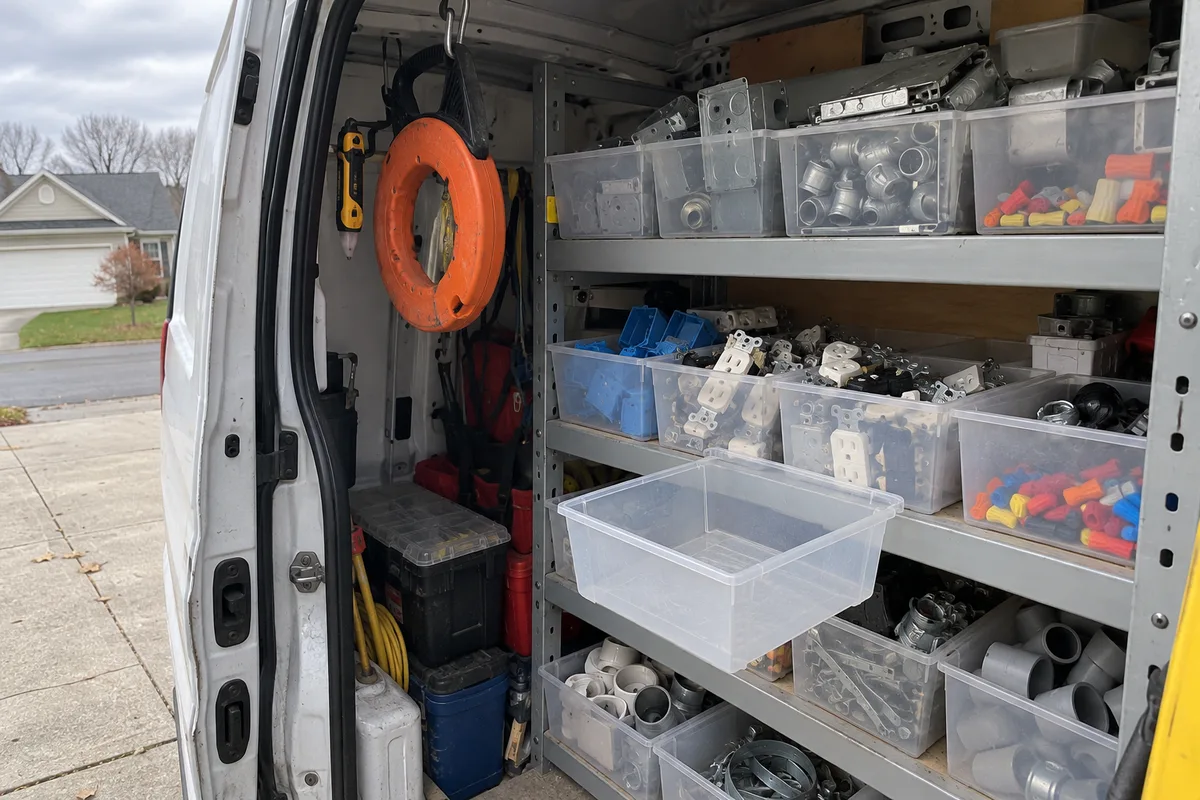
Keep these categories separate. A technician looking for a GFCI should not have to open a mixed box of receptacles, switches, and cover plates. A connector should have a fixed bin. Short raceway pieces should not be buried behind loose fittings.
Andrew Caulder of Miami Electric Masters, which has four vans, buys in retail packaging to keep things neat. His point was direct: “If you save time, you save money.”
Retail packaging is not the only way to organize. The requirement is simpler. The item needs to stay identifiable, protected, and easy to count. Loose parts create a searching problem and a restocking problem at the same time.
Every van needs the same layout
Murdy’s rule is specific: “All of your trucks should carry the same items in the same locations.”
Chris Crew, who operates Mister Sparky franchises in Florida with 43 electricians across four locations, uses shelving as a franchise standard. Parts are organized numerically and alphabetically in plastic bins with inventory lists. “No matter who drives that van, the part is in the same place.”
That matters when a technician covers another route, takes a different van, or needs help from the shop. A common layout removes the need to learn a new truck before starting the day.
Use the same shelf order, bin labels, and inventory list in every van. Put the frequently used items where they can be reached without unloading other material. Keep tools in their own locations. Keep consumable parts separated from items that need panel or job-specific confirmation.
Murdy also says that by organizing properly and not overstocking, you should be able to fit everything you need into an extended van. More stock is not the same as better stock. A crowded van slows the search and hides what is missing.
Restock what the technician used that day
Larry Warner of Absolute Electric in Vancouver, Wash., operates a one-ton van carrying more than 600 line items. He checks what was used each day and reorders immediately for the next workday.
That is the habit to copy. The restock check belongs at the end of the day, not when the technician discovers an empty bin on the next call.
Have the technician mark used material before closing out the day. The shop then replaces it, updates the inventory list, and handles any item that needs supplier delivery. If the part is not replaced, the van is not ready, even if the tools are still inside.
A daily check also exposes repeated shortages. If a part is used often enough to cause regular gaps, move it into the regular van stock list, increase the shop backup, or set up a supplier arrangement for daily delivery.
For small parts, Murdy recommends purchase orders supported by backup shop inventory or supplier contracts. Ask your distributor about consignment plans when that fits your operation.
Do not carry every odd part
Some parts do not belong in every van. A specialty breaker, unusual enclosure, or less common fitting can take up space without helping most calls.
For those parts, call the supplier before the appointment when the complaint and equipment information identify what is needed. If the part cannot be confirmed until diagnosis, tell the customer that a second material trip may be required. Quote that part trip as a separate line instead of silently eating the time.
This is also where call pricing needs a clear rule. Use your policy for what electricians charge for hourly, day-rate, and call-out work so the customer receives the same answer from the office and the field.
After-hours calls need their own process. The after-hours call policy every electrical shop needs should control escalation, dispatch, and the information the technician receives before leaving.
Put truck stock into the dispatch routine
The stock list, van layout, call intake, and restock check should operate as one process.
Before dispatch, read the complaint and identify the likely material category. Confirm the technician has the right kit for the room, device, or panel issue. Send the job summary to the technician’s phone. For urgent calls, follow your shop’s escalation rules rather than relying on a handwritten note or a verbal handoff.
At the end of the workday, check every item used and reorder it for the next workday. Keep the same items in the same locations across all vans. Review material invoices regularly, account for seasonality, and remove stock that does not match the calls you actually get.
That is what you should do differently: stop treating truck stock as a one-time shopping list. Build it from your invoices, load from the call summary, label every location, restock every day, and send the odd part through the supplier process instead of letting it become an unplanned second trip.